
Glycation: What Sugar Actually Does to Your Skin
Everyone knows sugar is bad, but most people do not know what that means on a biochemical level - for their skin, their collagen, and how fast they age.

.jpg)
Here is the thing about sugar and skin: the problem is not what you see. It is what happens years before anything becomes visible - deep in the dermis, where your collagen lives.
The mechanism is called glycation. And once you understand it, the usual advice – 'eat less sugar, wear sunscreen' – starts to make even more sense.
1. What Happens When Sugar Binds to Collagen
Glucose and fructose do more than circulate. At elevated levels, they bind to the proteins they encounter – including collagen and elastin, the structural proteins that give skin its firmness and elasticity. This binding is not a controlled biological process. It simply happens, as a chemical reaction, whenever sugar levels are consistently high.
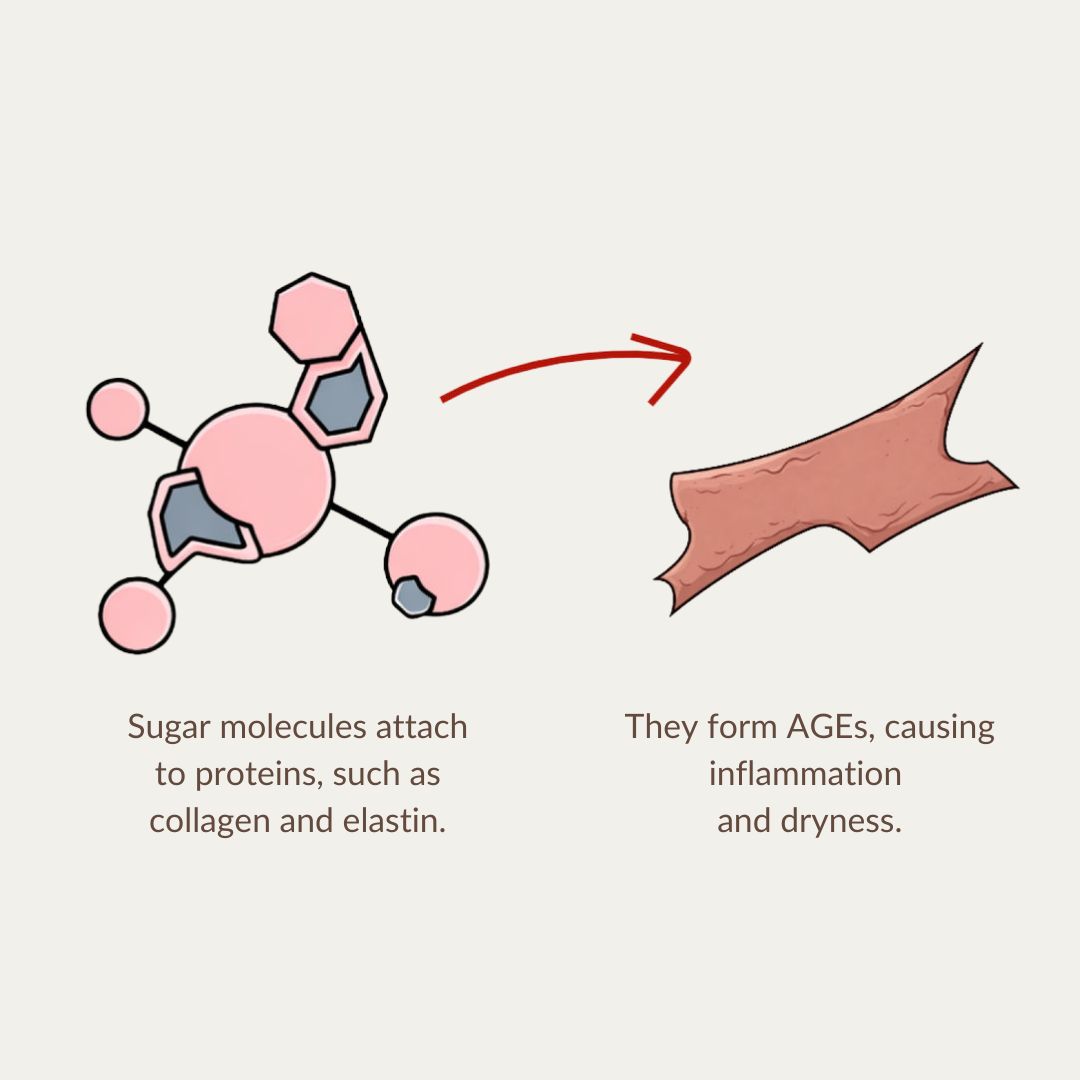
This binding produces Advanced Glycation End Products, or AGEs. AGEs create permanent cross-links between collagen fibers - stiffening and yellowing them and making them resistant to normal renewal processes. Collagen that should be broken down and replaced simply accumulates.
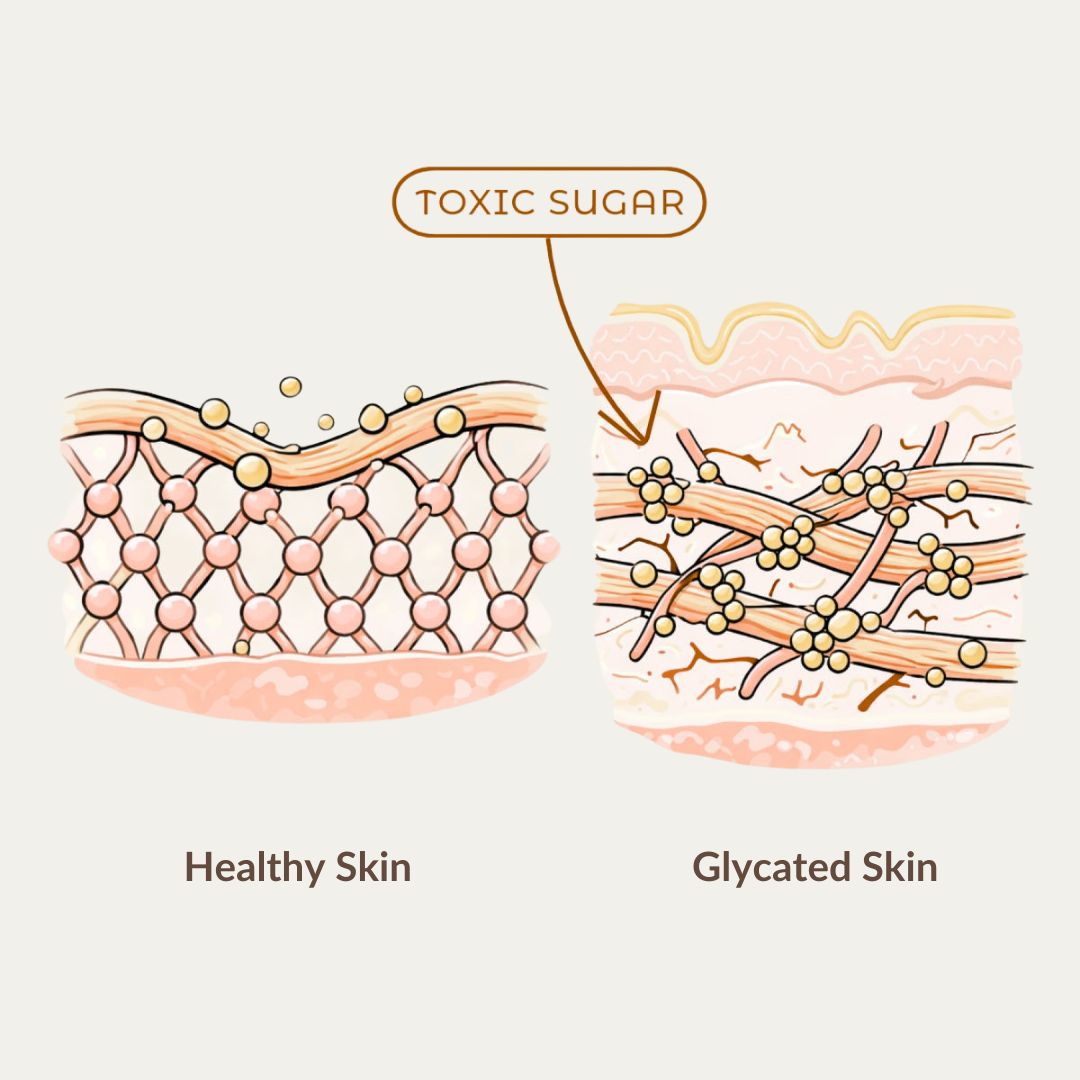
The problem is compounded by how slow collagen turnover is. Some collagen fibers in the dermis are decades old. Glycated collagen breaks down slowly. In people with diabetes or chronic insulin resistance, AGE levels in the skin can be 3–5 times higher than in metabolically healthy individuals.
Glycation is not a diabetes problem
You do not need a diagnosis of diabetes for glycation to affect your skin. Diets with a consistently high glycaemic load and early metabolic changes can already accelerate the formation of advanced glycation end products (AGEs)
This makes glycation relevant for most adults in modern food environments.
2. Why Sugar + UV = Exponentially Worse Damage
On their own, glycation and UV exposure are both significant drivers of skin aging. Together, they compound - they are dyssynergistic. A 2024 study in Nature Scientific Reports found that glyoxal-derived AGEs combined with UVB irradiation triggered up to 3 times more inflammatory signalling than either stressor alone.
The mechanism runs through RAGE signalling - the receptor for advanced glycation end products. When RAGE is activated, it switches on NF-kB and COX-2, two well-studied molecular drivers of chronic inflammation. This cascade:
- Increases matrix metalloproteinases (MMPs), enzymes that accelerate collagen breakdown and disrupt the skin’s structural framework
- Elevates reactive oxygen species (ROS) that damage DNA and cellular structures
- Stimulates melanin production, contributing to unwanted hyperpigmentation
- Keeps skin in a state of chronic low-grade inflammation, accelerating all hallmarks of skin aging
Glycation and UV damage are not independent stressors - their negative effects amplify each other (they are dyssynergistic). Recent research shows that AGEs combined with UV exposure can trigger up to 3 times more inflammatory activity than either alone, through a receptor pathway called RAGE that drives collagen degradation, oxidative stress, and unwanted hyperpigmentation simultaneously.
Practical implication
SPF is important for everyone. It is especially important if your diet is consistently high in sugar, because UV is not just an independent stressor. It is a multiplier on glycation damage already in your skin.
3. Why Glycated Skin Cannot Renew Itself Easily
Normal collagen renewal depends on fibroblasts - the cells that produce new collagen - and on MMPs.
Glycation disrupts both sides of this process. Glycated collagen is physically resistant to MMP breakdown: the cross-links make it harder to degrade, so damaged fibers accumulate rather than being cleared. At the same time, fibroblasts exposed to AGEs become senescent: they slow their collagen output and start secreting inflammatory signals instead.
The result is skin that looks and feels thicker, less elastic, and dull, because the collagen that remains has been structurally altered and the normal renewal cycle has been disrupted. AGE cross-links themselves are biochemically irreversible, meaning that once these sugar-derived bonds form between collagen fibers, the body cannot simply break them down or repair them. What is possible, however, is stimulating enough new collagen production to dilute and structurally replace the glycated tissue over time.
4. What You Can Do About It
No single product or treatment reverses glycation. But a layered approach addressing diet, topicals, and clinical stimulation meaningfully slows the process and restores collagen quality over time.
The honest summary: prevention is more effective than reversal. Keeping blood sugar stable, wearing SPF daily, and using retinoids consistently from your thirties prevents glycation damage from accumulating in the first place. For skin in which glycation has already progressed, biostimulators and medical RF Microneedling are the most evidence-based tools we have for replacing structurally compromised collagen.
Key Insights
- Glycation is the irreversible binding of sugar to collagen, creating stiff, yellowed, cross-linked fibers that resist renewal.
- Sugar + UV are synergistic: up to 3x more inflammatory damage than either alone. SPF matters more if your diet is high in sugar.
- Glycated skin cannot easily renew itself: fibroblasts become senescent, collagen accumulates rather than clearing.
- Prevention first: low-GI diet, daily SPF, retinoids from your 30s.
- For reversal: biostimulators and RF Microneedling are the most effective clinical tools for rebuilding what glycation has degraded.
Sources:
- Advanced Glycation End Products in the Skin – Frontiers in Medicine https://www.frontiersin.org/journals/medicine/articles/10.3389/fmed.2022.837222/full
- Advanced glycation end products: Key players in skin aging? – PMC, https://pmc.ncbi.nlm.nih.gov/articles/PMC3583887/
- Research Advances on the Damage Mechanism of Skin Glycation – PMC, https://pmc.ncbi.nlm.nih.gov/articles/PMC9655929/
- Glyoxal-derived AGEs with UVB critically induce skin inflammaging – Nature (2024), https://www.nature.com/articles/s41598-024-52037-z
- Synthetic and Natural Agents Targeting AGEs – MDPI Antioxidants (2025) https://www.mdpi.com/2076-3921/14/4/498
- The effects of glycation on collagen's stability – ScienceDirect (2025), https://www.sciencedirect.com/science/article/pii/S0945053X24001495
- Advanced glycation end products and health – Springer (2024), https://link.springer.com/article/10.1007/s10439-024-03499-9
- Effect of topical collagen tripeptide on antiglycation – MDPI (2022), https://www.mdpi.com/1422-0067/23/3/1101

.jpg)
.jpg)
.jpg)
.jpg)
.jpg)
.jpg)
.jpg)
.jpg)
.jpg)
.jpg)
.jpg)
.jpg)

.jpg)
.jpg)
.jpg)