
How to Boost Collagen with Vitamin C
In this issue of the everskin Skin Longevity Journal, we explore how Vitamin C powers collagen synthesis, what intake best supports healthy skin structure, and how to maintain it through winter.


You are supplementing protein, maybe even collagen. But are you giving your skin what it truly needs to build collagen?
Without the right amount of Vitamin C, your body cannot transform the amino acids that are those supplements into stable collagen fibers.
The Science: Why Vitamin C Matters
Think of collagen as the framework of your skin: a protein network built from amino acids such as glycine, proline, and lysine.
Inside your skin’s cells, Vitamin C activates enzymes that stabilize new collagen strands, turning them into strong, resilient fibers. Without this step, collagen remains fragile and easily broken down.
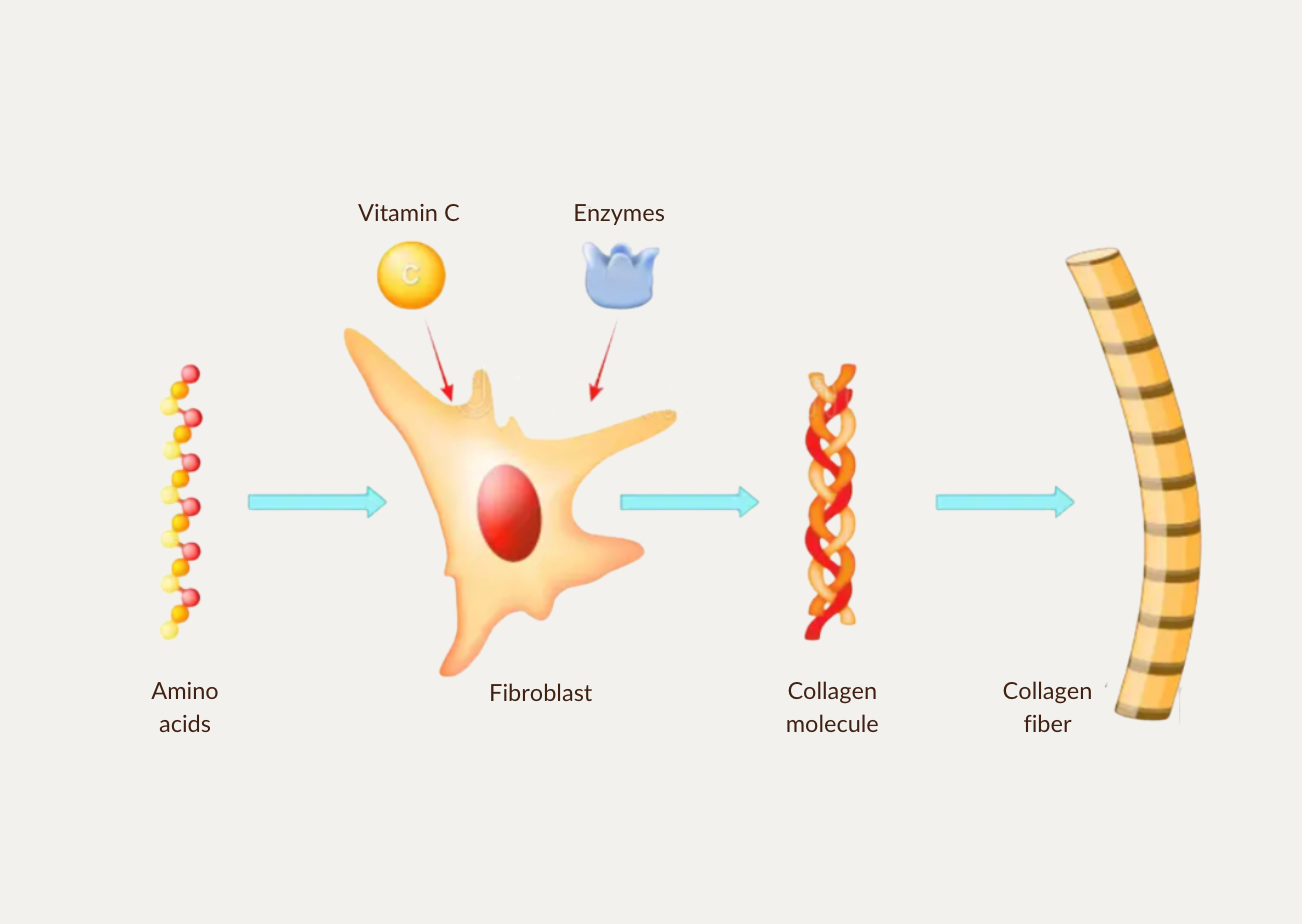
Research shows that when Vitamin C levels are low, fibroblasts – the cells responsible for producing collagen – slow down. When Vitamin C levels are optimal, fibroblasts work more efficiently and Type I collagen increases within skin tissue.
Vitamin C can also act as a powerful antioxidant when applied topically in sufficiently high concentrations (10–20% L-ascorbic acid). In this form, it neutralizes free radicals created by UV exposure and pollution, two major triggers of collagen loss. Although dietary Vitamin C supports collagen synthesis from within, achieving optimal antioxidant protection in the skin will additionally require applying skincare with sufficiently high levels of Vitamin C.
How Much Is Enough?
Guidelines issued by the European Food Safety Authority (EFSA) recommend about 95–110 mg per day for adults.U.S. National Institutes of Health (NIH) guidelines are similar at 90 mg for men and 75 mg for women.
Studies that track collagen markers suggest that a daily intake of 100–200 mg best supports collagen formation and antioxidant protection.
For reference, here is the typical Vitamin C content of everyday foods:
- 1 medium orange: ≈ 70 mg
- 1 kiwi: ≈ 90 mg
- 100 g broccoli: ≈ 85 mg
- 100 g red bell pepper: ≈ 150–190 mg
Can You Have Too Much Vitamin C?
More is not always better.
Because Vitamin C is water-soluble, the body absorbs only what it needs and eliminates the rest.
Above about 200 mg per dose, absorption reaches a plateau. The additional Vitamin C simply leaves the body through urine.
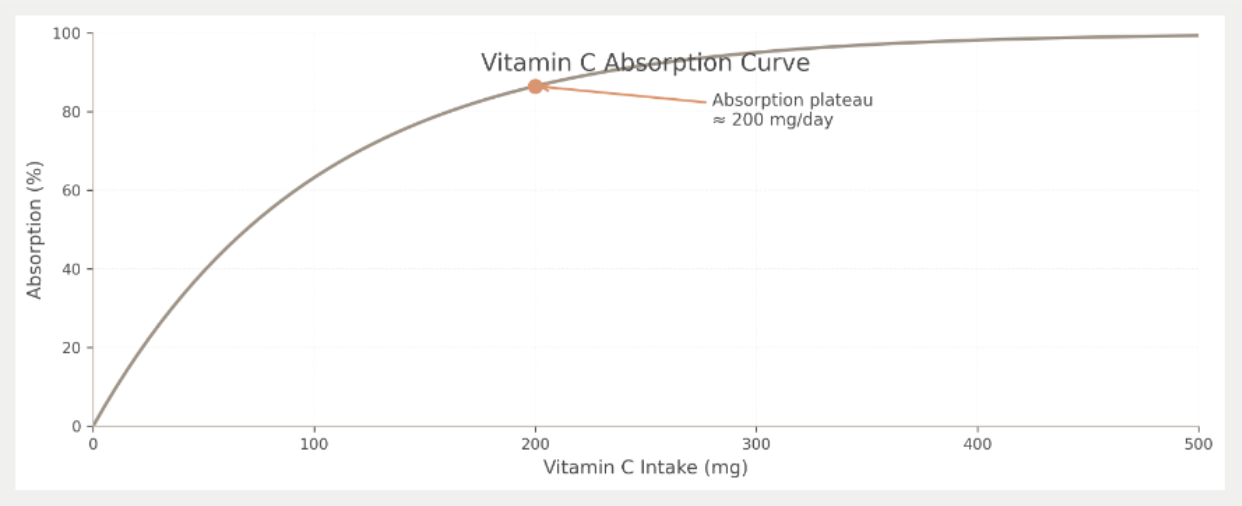
Very high doses (more than 1,000–2,000 mg per day) may cause mild digestive discomfort or, in rare cases, contribute to kidney stone formation in predisposed individuals.
For healthy adults, consistent daily intake is far more important than large single doses.
Your skin benefits from steady support, not excess.
The Sources: Beyond Oranges
Switzerland offers many Vitamin C-rich foods all year round.
- Red bell peppers: 150–190 mg per 100 g
- Kiwi: ≈ 90 mg per 100 g
- Broccoli: ≈ 85 mg per 100 g
- Sauerkraut: retains Vitamin C through fermentation and remains a classic Swiss winter staple
- Apples (stored): ≈ 5–10 mg per 100 g
- Potatoes: a surprisingly valuable source
- raw ≈ 17 mg per 100 g
- cooked with skin ≈ 14–19 mg per 100 g
- peeled boiling = 40–50 % loss
Tip: Steam or boil potatoes with the skin to minimize nutrient loss. Because they are eaten frequently, they can meaningfully contribute to total Vitamin C intake.
The Bottom Line: Inside and Out
Vitamin C is the biochemical switch that allows collagen to form correctly and stay intact.
From the inside, dietary Vitamin C supports collagen formation. Maintaining a steady intake of around 100–200 mg per day provides the substrate your fibroblasts need to build collagen efficiently.
During the Swiss winter, when fruit and vegetable intake often drops, a 100–200 mg supplement can help maintain optimal levels. Vitamin C is water-soluble, so any excess is excreted naturally.
From the outside, well-formulated Vitamin C serums (10–20% L-ascorbic acid) protect existing collagen from UV damage and stimulate new production. Combined with daily SPF 30+, this approach strengthens collagen and reduces environmental stress that accelerates aging.
When your nutritional base is solid, RF Microneedling, Biostimulators, or Low-Level Light Therapy (LLLT) can further enhance results by directly stimulating collagen renewal.
You provide the substrate; we deliver the stimulus.

.jpg)
.jpg)
.jpg)
.jpg)
.jpg)
.jpg)
.jpg)
.jpg)
.jpg)
.jpg)
.jpg)
.jpg)
.jpg)
.jpg)
.jpg)
.jpg)